


A bridge of memory and gratitude that supports Sicily from America
***
The longest single-span bridge in the world linking the United States directly to Sicily across an ocean. Not a physical infrastructure, like the one that is supposed to connect the Ionian and Tyrrhenian shores between Scylla and Charybdis. Rather, a kind of umbilical cord—one that ties many American families even more closely to Sicilians, families that often have distant Sicilian roots.
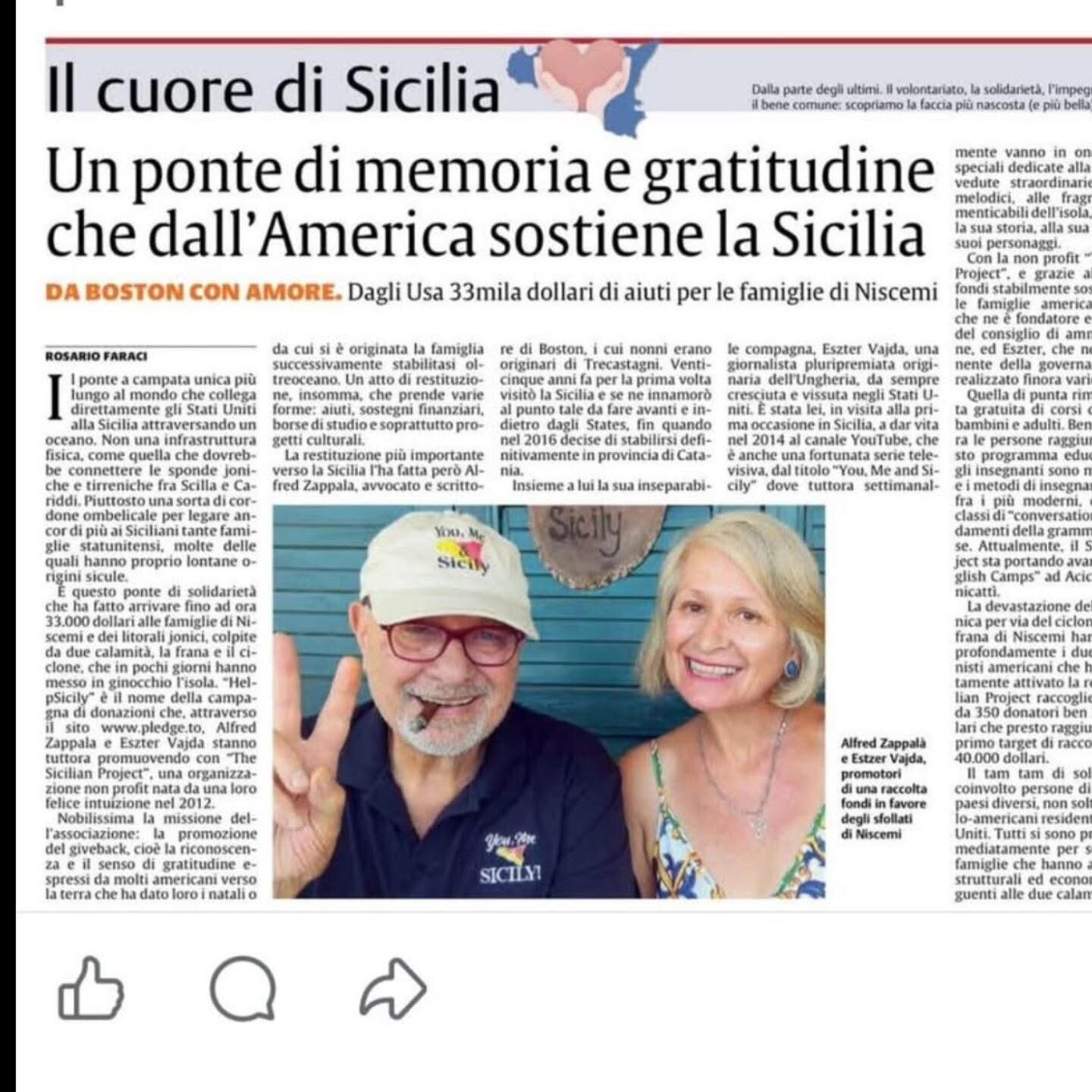
It is this bridge of solidarity that has so far brought 33,000 dollars to the families of Niscemi and the Ionian coastline, struck by two calamities—a landslide and Cyclone Harry—which in just a few days brought the island to its knees. “HelpSicily” is the name of the fundraising campaign that Alfred Zappala and Eszter Vajda are still promoting through the website www.pledge.com, together with “The Sicilian Project,” a nonprofit organization born from their inspired idea back in 2012.
The association’s mission is a noble one: promoting “giveback,” that is, the gratitude and sense of recognition expressed by many Americans toward the land where they were born—or from which their family originated before later settling overseas. In short, an act of giving back that can take many forms: aid, financial support, scholarships, and above all cultural projects.
Yet the most important act of giving back to Sicily was made by Alfred Zappala himself, a Boston-based lawyer and writer whose grandparents came from Trecastagni. Twenty-five years ago, he visited Sicily for the first time and fell in love with it—so much so that he began traveling back and forth from the States until, in 2016, he decided to settle permanently in the province of Catania.
Rosario Faraci, La Sicilia February 13, 2026
At his side is his inseparable partner, Eszter Vajda, an award-winning journalist originally from Hungary, who has lived and grown up in the United States. It was she—during her first visit to Sicily—who created, in 2014, the YouTube channel that also became a successful TV series titled “You, Me and Sicily,” where special episodes dedicated to Sicily still air weekly: its extraordinary views, melodious sounds, unforgettable fragrances, along with its history, culture, and people.
Through the nonprofit “The Sicilian Project,” and thanks to steady fundraising supported by American families, Alfred—founder and chairman of the board—and Eszter—a member of its governing body—have carried out several initiatives to date. The flagship project remains the free offering of English courses for children and adults. So far, 2,000 people have been reached through this educational program, where teachers are native speakers and teaching methods are among the most modern, combining “conversation” classes with the fundamentals of English grammar. At present, The Sicilian Project is running two “English Camps” in Acicatena and Canicattì.
The devastation of the Ionian coast caused by Cyclone Harry and the landslide in Niscemi deeply shook the two American professionals, who promptly activated The Sicilian Project’s network, quickly raising—thanks to 350 donors—33,000 dollars, a figure that will soon meet the first fundraising target set at 40,000 dollars. This wave of solidarity has reached people in twelve different countries, not only Sicilian-Americans living in the United States.
Everyone mobilized immediately to support the families who suffered structural and economic damage as a consequence of the two disasters.


